
As organisations increasingly demand measurable outcomes from their learning investments, selecting the right training reporting platforms has become a strategic priority. Reporting is no longer limited to completion tracking; businesses now expect real-time analytics, skills mapping, compliance monitoring, and AI-driven insights.
In our previous discussion on how to create automated training reports for employee progress, we explored the principles behind effective reporting. This article explores the top training reporting platforms for businesses and what decision-makers should consider when evaluating them. For organisations working with specialist partners such as Learning Elements, choosing the right platform ensures that instructional design, facilitation, and learning strategy are fully supported by meaningful data.
What to Look for in Training Reporting Platforms
Before reviewing specific systems, it’s important to understand the features that define a strong reporting solution:
- Customisable dashboards for different stakeholder groups
- Automated report scheduling and distribution
- Skills and competency tracking
- Compliance and audit-ready exports
- Integration with Human Resource Information Systems (HRIS) or performance systems
- AI-enhanced analytics and predictive insights
- Accessibility and localisation options
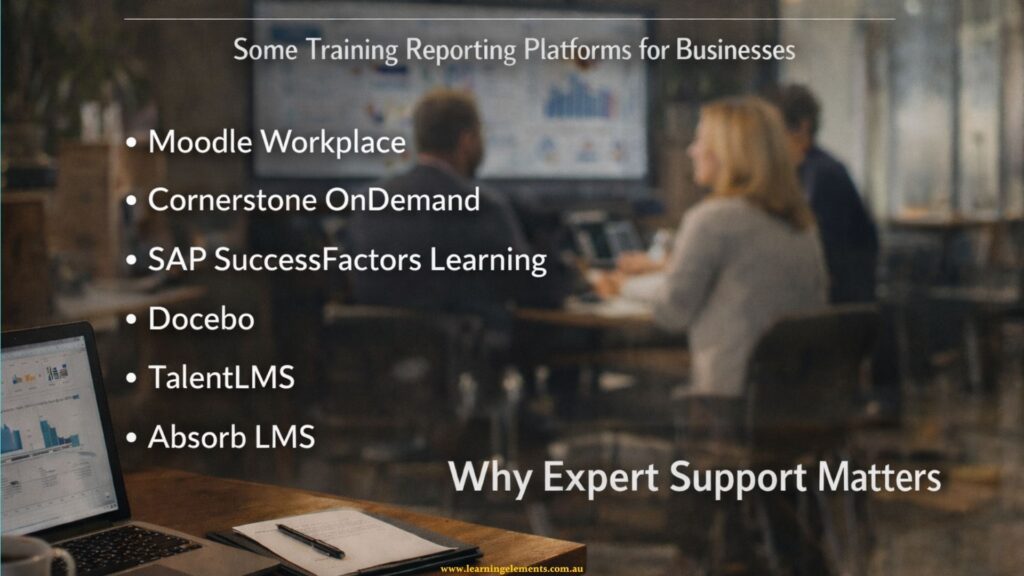
Top Training Reporting Platforms for Businesses
1. Moodle Workplace
Moodle Workplace is a tailored, open-source learning management system designed for corporate training, onboarding, and compliance. Built on the well-known Moodle framework, it offers advanced features such as multi-tenancy for managing separate branded workspaces, automated workflows, organisational structure management, and custom reporting tools. These capabilities make it a flexible and scalable option for organisations that require detailed training reporting and the ability to track employee progress across different teams or business units.
Reporting Strengths:
- Custom report builder with filtering by role, department, or cohort
- Multi-tenant reporting for organisations with separate divisions
- Compliance tracking tools
- Plugin flexibility for advanced analytics
2. Cornerstone OnDemand
Cornerstone OnDemand is an enterprise learning management platform designed to help organisations deliver training at scale while supporting workforce development. It enables businesses to mobilise learning, personalise upskilling pathways, and unify workforce data in one system. With advanced analytics and reporting capabilities, organisations can track employee progress, monitor skill development, and generate insights that support more agile and data-driven learning strategies.
Reporting Strengths:
- Real-time dashboards
- Workforce capability tracking
- AI-supported skills intelligence
- Executive-ready visual reporting
Cornerstone is particularly suited to larger organisations that require enterprise-level data integration across talent management systems.
3. SAP SuccessFactors Learning
SAP SuccessFactors Learning is a cloud-based learning management system within the SAP Human Capital Management suite, designed to support employee development, skills building, and regulatory compliance. The platform enables organisations to create, assign, and track training while integrating AI-driven recommendations and external content libraries. Its reporting and analytics tools allow businesses to monitor learner progress, track certifications, and generate insights that support workforce development and compliance management across global teams.
Reporting Strengths:
- Deep integration with HR and performance data
- Regulatory compliance monitoring
- Automated certification tracking
- Advanced analytics for global teams
For multinational businesses, this platform’s localisation capabilities are especially valuable.
4. Docebo
Docebo is an AI-powered learning management system designed to help organisations train employees, partners, and customers through a single unified platform. It offers advanced reporting and analytics features that allow businesses to track learner progress, measure engagement, and analyse training performance. With AI-driven insights and customisable dashboards, organisations can generate meaningful training reports that support data-informed learning strategies and continuous workforce development.
Reporting Strengths:
- AI-generated insights and recommendations
- Customisable dashboards
- Learner engagement tracking
- Social learning analytics
Its AI functionality supports the kind of intelligent analysis we discussed previously when exploring prompts to enhance AI in training reporting.
5. TalentLMS
TalentLMS is a cloud-based learning management system that helps businesses create, deliver, and manage online training for employees, customers, and partners. The platform supports a wide range of training needs, including onboarding, compliance, skills development, and sales enablement. With features such as AI-assisted content creation, assessments, gamification, and system integrations, TalentLMS also provides clear reporting tools that allow organisations to track learner progress, monitor completion rates, and generate training reports that support informed learning and development decisions.
Reporting Strengths:
- Pre-built and custom reports
- Completion and assessment tracking
- Exportable compliance data
- Clear visual summaries
While not as complex as enterprise systems, it provides strong core reporting features suitable for growing organisations.
6. Absorb LMS
Absorb LMS is a cloud-based, AI-powered learning management system designed to support corporate training, employee onboarding, and compliance programs. The platform offers advanced reporting capabilities through tools such as Absorb Analyze reporting and analytics tools, allowing organisations to generate detailed training reports and monitor learner progress across teams. With intelligent content recommendations, personalised learning paths, and integrations with workplace tools like Microsoft Teams and Salesforce, Absorb LMS enables organisations to deliver training while maintaining clear visibility of learning performance and outcomes.
Reporting Strengths:
- Scheduled automated reports
- Advanced filtering and segmentation
- E-commerce reporting (for customer training)
- Business intelligence integrations
Its flexibility makes it appealing for organisations delivering both internal and external training.
RELATED READ: Training Reporting Dashboards That Integrate with LMS Systems
Making the Most of Modern Training Reporting Platforms
As learning technologies continue to evolve, organisations benefit greatly from staying current with modern training reporting platforms. These systems now go far beyond basic course completion tracking. Today’s platforms provide deeper insights into employee progress, engagement patterns, skills development, and organisational capability.
Core Benefits of Modern Training Reporting Platforms
Businesses adopting advanced reporting platforms often gain several key advantages:
- Real-time learning insights that support faster decision-making
- Clear visibility of workforce skills and capability gaps
- Improved compliance monitoring and audit readiness
- Better alignment between learning programs and business outcomes
- Scalable reporting structures that grow alongside the organisation
For organisations investing in professional learning strategies, these capabilities transform reporting into a strategic asset rather than an administrative task.
Choosing from the many training reporting platforms available can be challenging. The right platform should support your learning strategy, reporting requirements, and future organisational growth. Expert guidance can help ensure the platform you select aligns with your learning design and reporting goals.

Connecting Platform Choice to Strategy
Selecting among these training reporting platforms should not be a purely technical decision. The platform must support:
- Clearly defined learning outcomes
- Meaningful automated reporting structures
- Continuous improvement cycles
- Accessible and inclusive design
- Regional and content localisation where required
Common Challenges
Despite the benefits, many organisations encounter challenges when implementing training reporting platforms:
- Collecting large amounts of data without clear reporting objectives
- Difficulty integrating LMS reporting with HR or performance systems
- Limited internal expertise in configuring advanced reporting dashboards
- Reports that focus on completion rather than learning impact
- Inconsistent data across departments or regions
Without a clear reporting strategy, organisations may struggle to extract meaningful insights from their learning data.
Best Practices for Effective Training Reporting
To maximise the value of training reporting platforms, organisations should follow several best practices:
- Define clear reporting goals before selecting a platform
- Align reporting metrics with learning objectives and business outcomes
- Use automated reports to save time and improve consistency
- Design dashboards for different audiences, such as managers, executives, and L&D teams
- Regularly review reporting data to refine learning programs and close skills gaps
When reporting is integrated with strong instructional design and learning strategy, organisations can turn training data into valuable insight that supports continuous improvement.
Why Expert Support Matters
Even the most advanced training reporting platforms require strategic configuration. Without careful setup, organisations risk collecting large volumes of data without meaningful insight.
Learning Elements supports organisations by:
- Designing measurable learning programs
- Configuring LMS reporting structures
- Aligning reporting metrics to business KPIs
- Ensuring accessibility and compliance
- Supporting AI-enhanced reporting strategies
When platform capability is aligned with instructional expertise, reporting becomes a powerful tool for organisational growth.
Even the most advanced training reporting platforms require careful setup to deliver meaningful insights. With the right instructional design and LMS configuration, organisations can turn reporting data into measurable improvements in employee capability and performance.
The Role of AI in Modern Training Reporting Platforms
Many leading platforms now integrate AI features. When implemented responsibly, these tools can:
- Identify learners at risk of non-completion
- Detect skill gaps across departments
- Generate narrative summaries for managers
- Predict future training needs
However, AI reporting is only as effective as the instructional design behind the learning program. Structured assessments, measurable objectives, and aligned competencies remain essential foundations.
Conclusion
The best training reporting platforms are those that align technology with strategy. They support clear visibility of employee progress, enable evidence-based decision-making, drive continuous learning improvement, and deliver scalable and localised reporting. This allows organisations to move beyond basic completion tracking towards truly strategic learning analytics powered by automation and AI-driven insights.
If your organisation is evaluating training reporting platforms or looking to improve how training data is used, the right strategy makes all the difference. With the right platform and learning design approach, reporting becomes a powerful driver of workforce development.